Visual Language

Begin typing to search this documentation.

Greenways · Scene concept

Constellation Orchard

Constellation Orchard is a Greenways world concept built as a locked day-and-night mosaic place.

← Back to artwork catalogue
World
Greenways
Type
Day / night environment
Position
08 / 08

Greenways concept art

Constellation Orchard

Constellation Orchard by day: displaying naturally between two orchard rows
Daydisplaying naturally between two orchard rows
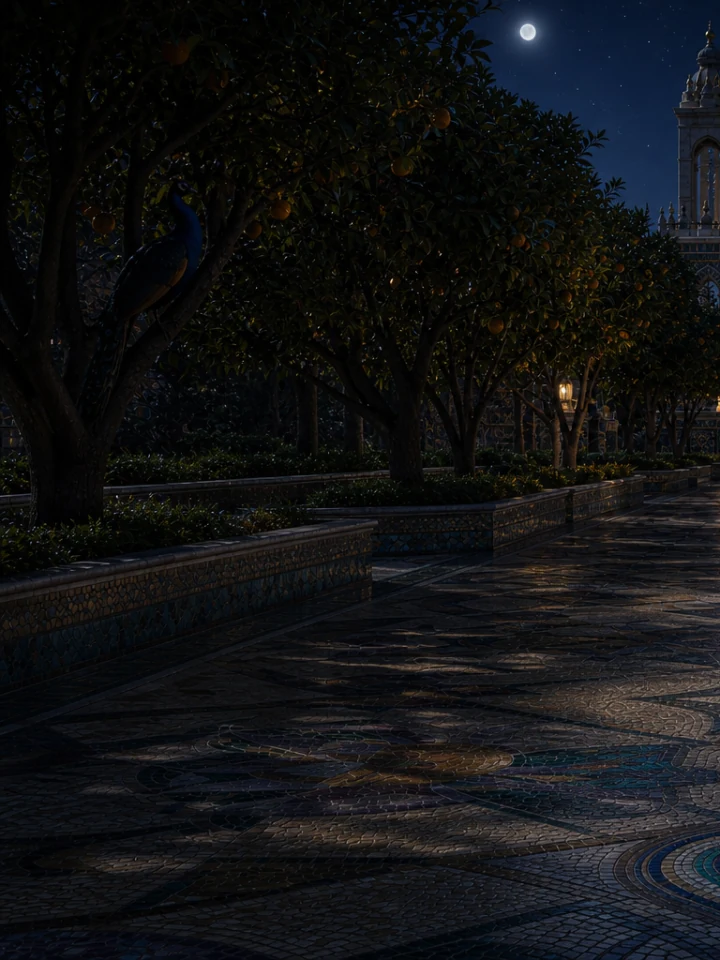
Constellation Orchard by night: roosting within the nearest mature tree
Nightroosting within the nearest mature tree
Locked between states
  • Place: a formal orchard on elevated terraces with star-patterned paving and distant towers
  • Camera: long axial view through the orchard
  • Affordance: the orchard floor supports display while the trees provide protected roosts
  • Responsive focus remains left
Allowed to change
  • Directional daylight becomes physically located moonlight and practical light
  • Reflections, weather, peripheral activity, and natural behaviour may change

Concept specification

Place
a formal orchard on elevated terraces with star-patterned paving and distant towers
Affordance
the orchard floor supports display while the trees provide protected roosts
Camera
long axial view through the orchard
Living subject
an anatomically natural peacock
Day behaviour
displaying naturally between two orchard rows
Night behaviour
roosting within the nearest mature tree
Palette
luxury emerald, verdigris, ivory, turquoise glass and pale gold
Materials
emerald and turquoise glass tesserae, ivory limestone, white marble, gold smalti and living trees
Why this concept exists

Place drives behaviour.

the orchard floor supports display while the trees provide protected roosts. The day and night states therefore express two credible uses of one environment rather than two unrelated illustrations.

  • The accepted day master establishes geometry, scale, crop, and material logic.
  • The night master edits that accepted composition instead of rebuilding the scene.
  • The subject remains anatomically natural and behaves because of the place.
  • The project identity appears through material, palette, and sparse architecture—not logo wallpaper.