Visual Language

Begin typing to search this documentation.

Hodos · Scene concept

Optical Garden

Optical Garden is a Hodos world concept built as a locked day-and-night mosaic place.

← Back to artwork catalogue
World
Hodos
Type
Day / night environment
Position
04 / 08

Hodos concept art

Optical Garden

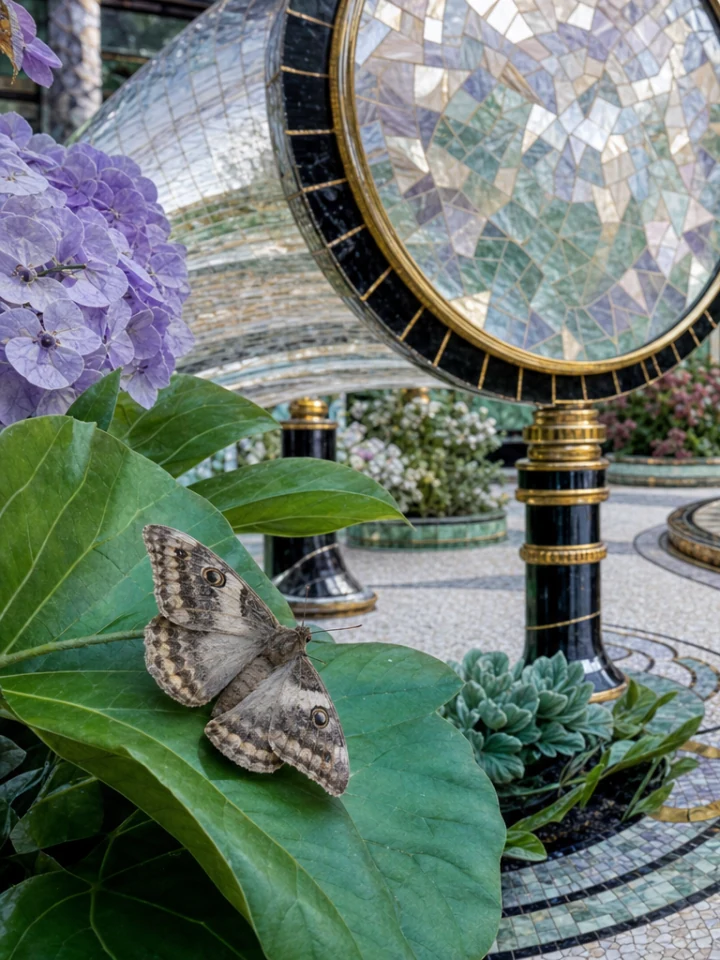
Optical Garden by day: resting on a foreground leaf in macro-sharp focus with the garden beyond
Dayresting on a foreground leaf in macro-sharp focus with the garden beyond
Optical Garden by night: hovering naturally above a luminous flower beside the reflecting pool
Nighthovering naturally above a luminous flower beside the reflecting pool
Locked between states
  • Place: an enclosed optical garden with magnifying glass structures, flowering plants and a reflecting pool
  • Camera: macro foreground subject within a wide garden environment
  • Affordance: a foreground leaf supports rest and a luminous flower attracts flight
  • Responsive focus remains left
Allowed to change
  • Directional daylight becomes physically located moonlight and practical light
  • Reflections, weather, peripheral activity, and natural behaviour may change

Concept specification

Place
an enclosed optical garden with magnifying glass structures, flowering plants and a reflecting pool
Affordance
a foreground leaf supports rest and a luminous flower attracts flight
Camera
macro foreground subject within a wide garden environment
Living subject
an anatomically natural moth at true scale
Day behaviour
resting on a foreground leaf in macro-sharp focus with the garden beyond
Night behaviour
hovering naturally above a luminous flower beside the reflecting pool
Palette
malachite, celadon, pearl, lilac glass, black onyx and gold
Materials
mother-of-pearl, malachite glass tesserae, veined stone, silk and aged mirror
Why this concept exists

Place drives behaviour.

a foreground leaf supports rest and a luminous flower attracts flight. The day and night states therefore express two credible uses of one environment rather than two unrelated illustrations.

  • The accepted day master establishes geometry, scale, crop, and material logic.
  • The night master edits that accepted composition instead of rebuilding the scene.
  • The subject remains anatomically natural and behaves because of the place.
  • The project identity appears through material, palette, and sparse architecture—not logo wallpaper.